
Resources / Current release review
What OpenClaw 2026.7.2-beta.3 Actually Changes
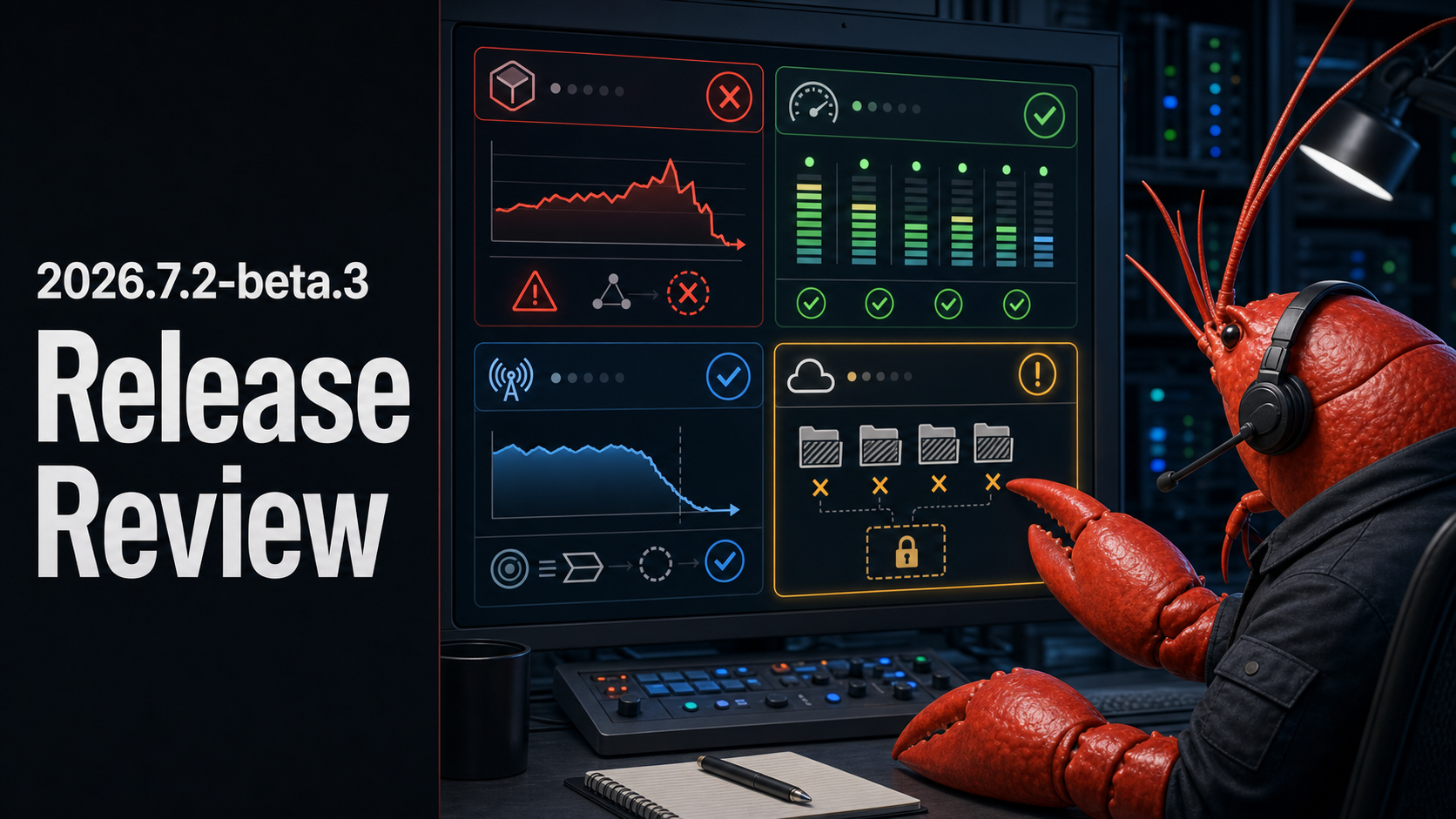
OpenClaw 2026.7.2-beta.3 is a focused operability follow-up: it makes broken Codex routes fail loudly, keeps Gateway control writes responsive, drains accepted Signal ingress during shutdown, and protects cloud-worker results from cache churn. Treat it as a support and recovery improvement, not as a broader rollout or memory baseline.
Upgrade notes to treat as real work
- Run
models status --checkwith enabled, disabled, missing, and quarantined Codex harness states; credential health alone no longer proves the route works. - Exercise interactive Gateway admin writes under load and confirm per-method limits preserve responsiveness without weakening runaway-loop protection.
- Stop Signal during accepted ingress and prove the message finishes exactly once before the monitor exits.
- Round-trip cloud-worker workspaces containing Python caches, dependency trees, and macOS metadata to verify derived files cannot fence worker reclaim or valid results.
What changed that actually matters
- Codex model diagnostics now fail loudly: a configured Codex route reports unavailable when its harness plugin is disabled, missing, or quarantined, while credential status remains a separate result.
- Gateway control-plane limits are more usable: per-method buckets with a 30-per-minute budget keep interactive admin writes responsive while retaining loop protection.
- Signal shutdown delivery is safer: already-accepted ingress drains before the monitor stops, reducing the gap where a just-received message could disappear.
- Cloud-worker reconciliation is less fragile: Python caches, dependency trees, and macOS metadata are excluded symmetrically so local cache rewrites cannot fence later cloud results or worker reclaim.
- Codex metadata caught up: the bundled CLI moved to 0.144.6 and GPT-5.6 context metadata aligns with the upstream 272k limit.
Why operators should care
What this does not change
- This does not prove broader autonomous memory, default session memory, a LanceDB migration, or widened Active Memory.
- This does not make cloud workers, Gateway controls, or Signal delivery healthy without local load, shutdown, retry, and reconciliation evidence.
- This does not replace 2026.7.1 as the conservative stable baseline for buyers who do not run prereleases.
- This should not widen product promises beyond the specific support and recovery surfaces changed here.
Risks and areas to watch
- Confirm diagnostics distinguish missing credentials from disabled, missing, or quarantined harness code without leaking secrets.
- Measure which Gateway methods consume separate buckets and how automation behaves after the 30-per-minute boundary.
- Test Signal shutdown across direct, group, approval, stop, and queued work so draining does not become duplication.
- Verify cache exclusions in both outbound sync and inbound reconciliation, including worker reclaim after local cache rewrites.
Which CWYN product fits this release best
The best-fit product remains the Native Memory Activation Kit, used here for runtime health, provider-route proof, delivery checks, recovery evidence, and rollback discipline—not as a claim that the release expands memory.
If multiple governance and architecture layers are moving together, use the OpenClaw Memory Architecture Bundle only after the narrow activation checks pass.
The practical takeaway
OpenClaw 2026.7.2-beta.3 is worth reviewing because it removes four quiet failure modes from support and recovery work. Upgrade when those surfaces matter, test the exact failure paths, and keep the public claim narrow: better operability evidence, not broader autonomy.
Need the checklist version?
Use the Production Safety Checklist to separate route, Gateway, delivery, worker, and rollback health before widening.
Need the kit update?
Start with the activation kit if the main problem is upgrade safety, provider-route diagnostics, delivery proof, or recovery evidence.
Release-eval rubric
- Change type: support, diagnostics, delivery, recovery, architecture
- Operator value: high
- Best-fit product: Native Memory Activation Kit
- Public-safe claim: operability hardening, not broader autonomy proof
What to keep conservative
- No default LanceDB migration language
- No session-memory default claim
- No broad Active Memory rollout claim
- No route or delivery claims without proofs